Case Study - From route optimization to an autonomous logistics operating layer
An intelligent logistics platform built at the intersection of optimization, dispatch intelligence, operational visibility, and scalable software engineering — moving beyond single-feature routing toward a full decision and operations infrastructure.
- Client
- Flio.ai
- Year
- Service
- Operations Research & Platform Engineering
Overview
The core challenge in logistics is rarely a single routing problem. It is the disconnection between planning, dispatch, fleet management, and delivery execution — operational layers that typically run in isolation, creating inefficiency, delayed decisions, and limited visibility.
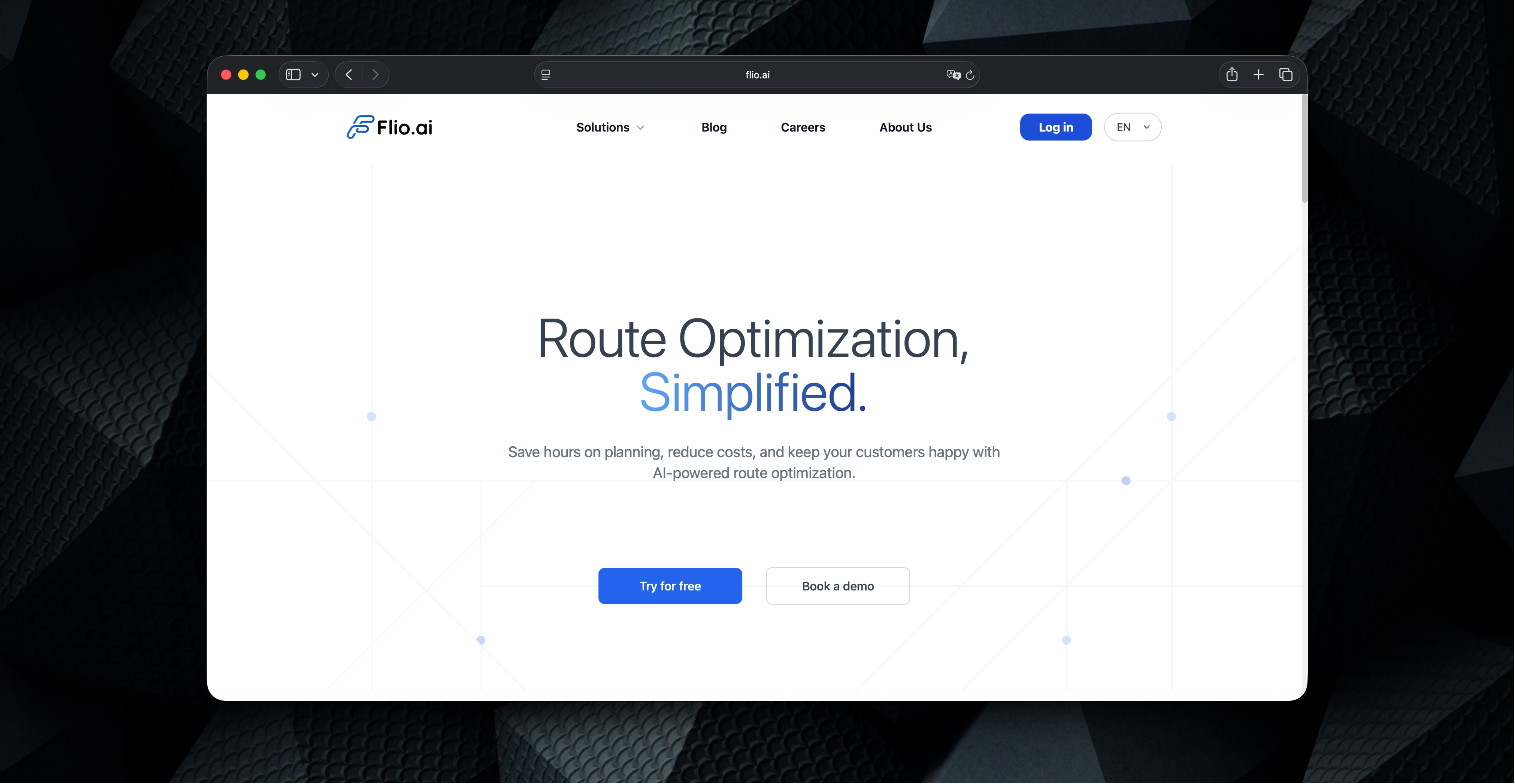
Flio.ai was built to address this at a structural level. Rather than offering a point solution for route calculation, the platform creates a logistics operating layer that connects optimization logic with real-time operational decision-making across the entire delivery chain.
Operations Research Foundation
At its core, Flio.ai reflects a strong Operations Research and Decision Analytics foundation. The optimization engine works across VRP, CVRP, and VRPTW problem families, applying mathematical modeling and advanced heuristics to produce operationally viable plans that balance cost, time, capacity, and service quality simultaneously.
What makes this distinctive is the translation of complex planning logic into usable digital products. Optimization models are not isolated inside technical environments — they are surfaced through modern interfaces that allow operations teams to interact with, adjust, and act on optimized plans in real time.
Platform Capabilities
The platform scope extends well beyond routing:
AI-powered route optimization forms the analytical core, generating optimized delivery plans that account for vehicle types, time windows, capacity constraints, and real-world cost structures including tolls, bridges, and sea crossings.
Fleet and driver management provides visibility into vehicle utilization, driver assignment, and operational status across the network.
Autonomous dispatch introduces decision logic that can assign orders, consolidate loads, and trigger operational actions with reduced manual intervention.
Digital twin simulation enables scenario analysis — testing the impact of new depots, demand changes, or fleet adjustments before committing to operational changes.
End-to-end visibility connects planning, execution, and delivery status into a single operational view.
Technical Architecture
The platform is built on a modern, scalable stack:
- Python / FastAPI backend for optimization services and API layer
- React and React Native for web and mobile interfaces
- Docker with CI/CD for consistent deployment
- AWS and Google Cloud infrastructure for scalable operations
- Custom 4D digital map infrastructure modeling Turkey-specific logistics realities including bridge, tunnel, highway costs, and sea crossings
What we delivered
- Route optimization engine
- Fleet management system
- Autonomous dispatch logic
- Digital twin simulation
- Python / FastAPI
- React & React Native
- Valuation reached
- $1M
- Optimization models
- 10+
- Digital map layer
- 4D
- Operational visibility
- End-to-end